

Posted 11 months ago 1988 views 6 mins read
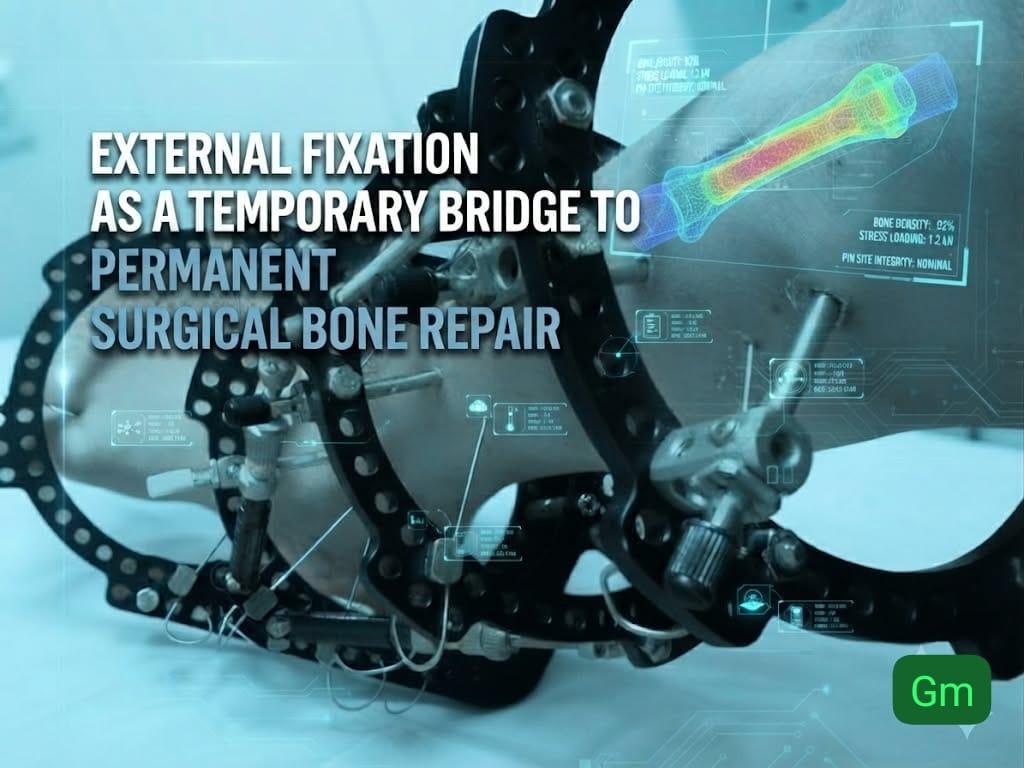
Here's a sobering reality that keeps trauma surgeons awake at night: 100% of polytrauma patients treated with external fixation survived their initial injuries in a recent study, yet many practitioners still hesitate to use this life-saving technique as a temporary bridge to definitive care. That statistic alone should make every orthopedic surgeon reconsider their approach to damage control orthopedics. The operating room is chaotic. Your patient arrives with multiple injuries, unstable vitals, and a mangled lower extremity that demands immediate attention. Do you commit to a lengthy definitive repair that could push an already compromised patient over the edge? Or do you buy time with external fixation, knowing that this temporary solution might just be the difference between life and death?
External fixation isn't giving up it's playing chess while others play checkers. This temporary stabilization technique has evolved from a last resort into a sophisticated damage control strategy that's revolutionizing trauma care. The numbers don't lie: 38.5% of patients initially treated with external fixation successfully convert to internal fixation, while 23% find that external fixation serves as their definitive treatment.

But here's what the textbooks don't always emphasize: timing is everything. The sweet spot for conversion lies between 7 and 60 days post-injury, with an average of 12.4 days providing optimal outcomes. Wait too long, and complications multiply. Move too fast, and you're operating on compromised tissue.
Let's address the elephant in the room complications. Pin tract infections remain the most common concern, affecting up to 24.2% of patients when fixators remain in place for 43-90 days. However, this drops to 19.6% when removed within 42 days. These aren't just statistics; they represent real patients whose outcomes depend on your clinical decision-making.
The data reveals a clear pattern:
•Gustilo grade IIIa fractures: 8.8% infection rate, 2.9% nonunion rate
•Gustilo grade IIIb fractures: 25% infection rate, 33% nonunion rate
This dramatic difference underscores a critical principle: external fixation works brilliantly for grade IIIa and below, but grade IIIb injuries require a different level of vigilance and often alternative strategies.
Converting from external to internal fixation isn't just about calendar days it's about reading your patient's biology. The key indicators that signal readiness for conversion include:
• Soft tissue recovery: The wound must show signs of healing without active infection or excessive drainage. Visual inspection remains your best diagnostic tool.
• Inflammatory markers: C-reactive protein (CRP) should show a downward trend from its peak value. This biochemical signal often precedes visible tissue improvement.
• Patient stability: Hemodynamic stability and resolution of systemic inflammatory response syndrome (SIRS) are non-negotiable prerequisites.
• One fascinating finding from recent research: 83% of nonunion cases and two-thirds of infection cases were successfully salvaged with just one additional procedure. This resilience speaks to the robust healing potential that external fixation preserves when used appropriately.

The most successful conversions happen when surgeons resist the urge to rush. I've observed that the best outcomes occur when three conditions align: the soft tissue envelope has recovered, inflammatory markers are trending downward, and the patient's overall condition permits a more extensive procedure.
Read also : A Simple Glue Could End the Era of Metal Plates in Bone Repair
Consider this approach revolutionary rather than conservative. You're not delaying definitive care you're optimizing the conditions for definitive success. The temporary nature of external fixation allows tissues to recover from the initial trauma while maintaining fracture alignment and preventing further soft tissue compromise.
External fixation as a bridge to definitive repair represents more than just a treatment option it's a paradigm shift toward biology-respecting trauma care. The technique acknowledges that sometimes the best intervention is the one that gives your patient's body time to prepare for definitive repair.
Recent advances in external fixation systems have made application faster and more precise. Modern quick-connect systems can be applied in minutes rather than the hour-long procedures of the past. This efficiency is crucial in damage control scenarios where every minute counts.

The evidence is compelling: when used judiciously as a temporary bridge, external fixation offers survival rates that should make it a cornerstone of your trauma protocol. The key lies not in avoiding complications they're inevitable in severe trauma but in managing them proactively and converting to definitive care at the optimal moment.
Leading the way in health excellence through innovation, expertise, care and support.