1 year ago


Posted 1 year ago 9724 views 8 mins read
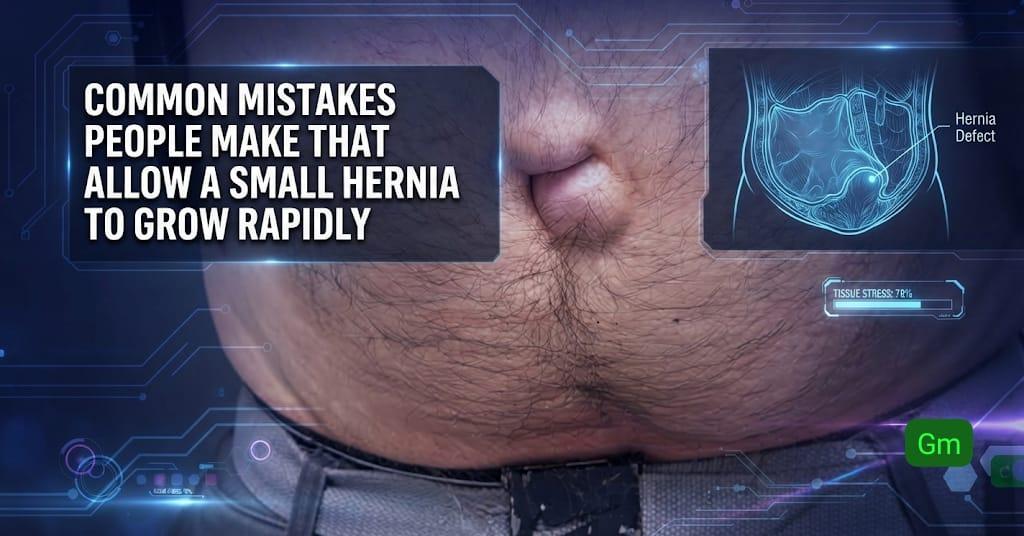
Heavy lifting was the most frequently reported precipitating cause for abdominal wall hernia, cited by 43.3% of patients in recent medical research. Yet here's the shocking truth that most people don't realize: it's not the heavy lifting itself that's the problem it's the countless small mistakes people make afterward that transform a manageable small hernia into a medical emergency requiring immediate surgery. I've spent years counseling patients who say things like "It's just a tiny bulge, I can live with it" or "I'll deal with it when I have time." What they don't understand is that hernias follow a cruel mathematical principle: they never get smaller, only larger. Every day of delay, every improper movement, every ignored warning sign pushes them closer to a potentially life-threatening complication that affects up to 15% of patients. The stakes couldn't be higher. About 70% of men with an inguinal hernia who delay surgery will develop new or worsening symptoms within five years, and emergency hernia repairs carry significantly higher complication rates than planned procedures.
The most devastating mistake people make is assuming a small hernia equals a safe hernia. This couldn't be further from the truth! According to Cleveland Clinic , "A small hernia may never bother you much. But hernias do tend to grow bigger over time. The opening continues to weaken and stretch."
What's particularly insidious is that small hernias can actually be more dangerous than large ones in certain circumstances. A narrow opening can trap tissue more easily, leading to incarceration a condition where the herniated tissue becomes stuck and cannot be pushed back in.
Here's what happens inside your body when you ignore that "small" hernia:
•The weakened muscle or tissue wall continues to deteriorate under normal daily pressure
•Each cough, sneeze, or strain widens the opening incrementally
•Scar tissue can form around the opening, making it more rigid and prone to trapping organs
The herniated tissue itself can become enlarged and less mobile
I tell my patients: "Your hernia is not a static condition it's a progressive one that's working against you 24/7."

Patients often tell me, "I know I have a hernia, but I still need to lift things at work." The issue isn't necessarily that they're lifting it's how they're lifting. According to research from Hartford HealthCare, proper technique is crucial, and patients should:
•Bend from the knees, not at the waist
•Lift using leg muscles while keeping the back straight
•Avoid sudden, jerky movements
•Never hold your breath while lifting (this increases intra-abdominal pressure dramatically)
Read also : Hernia Repair Fixing a hernia to prevent complications.
For patients with small symptomatic hernias, medical guidelines recommend avoiding lifting more than 10-15 pounds to prevent hernia enlargement and incarceration. That's roughly the weight of a gallon and a half of milk! Yet I constantly see patients who think they can still handle 50-pound bags of mulch or furniture because "it's just a small hernia."
The mathematical reality is stark: every pound over the recommended limit exponentially increases the pressure on your already weakened abdominal wall.
Many patients miss the subtle signs that their hernia is transitioning from a manageable condition to a medical emergency. According to the American Society of Anesthesiologists, you should seek immediate medical attention if:
•A hernia bulge suddenly becomes larger than before
•The bulge used to go back inside but no longer does
•You develop fever along with hernia symptoms
•The area becomes red or discolored
•You experience sudden, severe pain or tenderness
•Symptoms of intestinal obstruction appear (nausea, vomiting, inability to pass gas)

What patients don't realize is how quickly a hernia can go from bothersome to dangerous. Medical literature shows that among patients with incarcerated hernias, 5% to 13% require emergency surgery, and 10% to 15% need intestinal resection due to tissue death.
The progression can happen within hours. I've seen patients go from "mild discomfort" to emergency surgery in less than 12 hours because they ignored early warning signs.
"I'll get it fixed when things slow down at work" is perhaps the most expensive sentence I hear from patients. The statistics paint a clear picture of what delayed treatment costs:
•Emergency hernia repairs have significantly higher complication rates than elective procedures
•The risk of chronic pain after surgery increases with emergency operations
•Hospital stays are longer for emergency cases
•The overall cost can be 3-5 times higher than planned surgery

While "watchful waiting" is sometimes appropriate for completely asymptomatic hernias, many patients misinterpret this as "ignore it and hope it goes away." True watchful waiting requires:
•Regular medical monitoring
•Strict adherence to activity restrictions
•Immediate attention to any symptom changes
•Understanding that surgery will eventually be necessary
Patients focus on obvious activities like lifting heavy objects but ignore the daily movements that continuously stress their hernia:
•Chronic coughing or sneezing without proper abdominal bracing
•Straining during bowel movements due to constipation
•Poor posture that increases intra-abdominal pressure
•Rapid weight gain that adds constant pressure to the abdominal wall

While you cannot strengthen a hernia away, you can modify your daily habits to minimize progression:
•Practice proper breathing techniques during exertion
•Address constipation proactively with diet and hydration
•Maintain good posture throughout the day
Control weight to reduce constant pressure on the abdominal wall
The decision for hernia repair isn't always elective. Emergency surgery becomes necessary when:
•Incarceration occurs (tissue becomes trapped)
•Strangulation develops (blood supply is cut off)
•Bowel obstruction results from the hernia
These complications can be life-threatening and require immediate surgical intervention.
If you have a hernia, the question isn't whether you'll need surgery it's when. Elective repair offers:
•Better surgical outcomes
•Lower complication rates
•Faster recovery times
•More surgical technique options
•Significantly lower costs
After years of treating hernia patients, I can say with certainty that the biggest mistake is underestimating the progression of this condition. A hernia is not a static problem you can manage indefinitely it's a structural weakness that will continue to worsen until properly repaired.
The patients who do best are those who take their "small" hernia seriously from the beginning. They modify their activities appropriately, seek timely medical care, and make informed decisions about treatment timing.
Don't let common mistakes transform your manageable hernia into a medical emergency. The choice and the timeline is still yours, but only if you act while you still have options.
Leading the way in health excellence through innovation, expertise, care and support.